Irit Hayon: We're not a supermarket for artists. 1of135 Gallery celebrates a decade


Irit Hayon: We are not a supermarket of artists
The 1of135 gallery marks a decade since its founding. Irit Hayon: “We decided to establish a gallery whose goal is to make art accessible,
what I call ‘art in jeans’”

Yuval: Hi Irit, good afternoon. How are you doing amid all the chaos around us?
Irit: Chaos isn’t even the word would you like me to elaborate?
Yuval: Absolutely.
Irit: Honestly, it’s not such a simple question these days, challenging days for all of us, and even more so for a mother of two daughters in uniform, one of them a combat soldier in Gaza. The nights aren’t really nights and the worries are at their peak, but we try to focus on creating, on the things that give us meaning and maybe a little optimism.
Yuval: Absolutely, what would we do without creating. And in the middle of all this, a new exhibition and ten years for the 1of135 gallery, so first of all, double congratulations. What should we talk about first?
Irit: I think we’ll start with the gallery
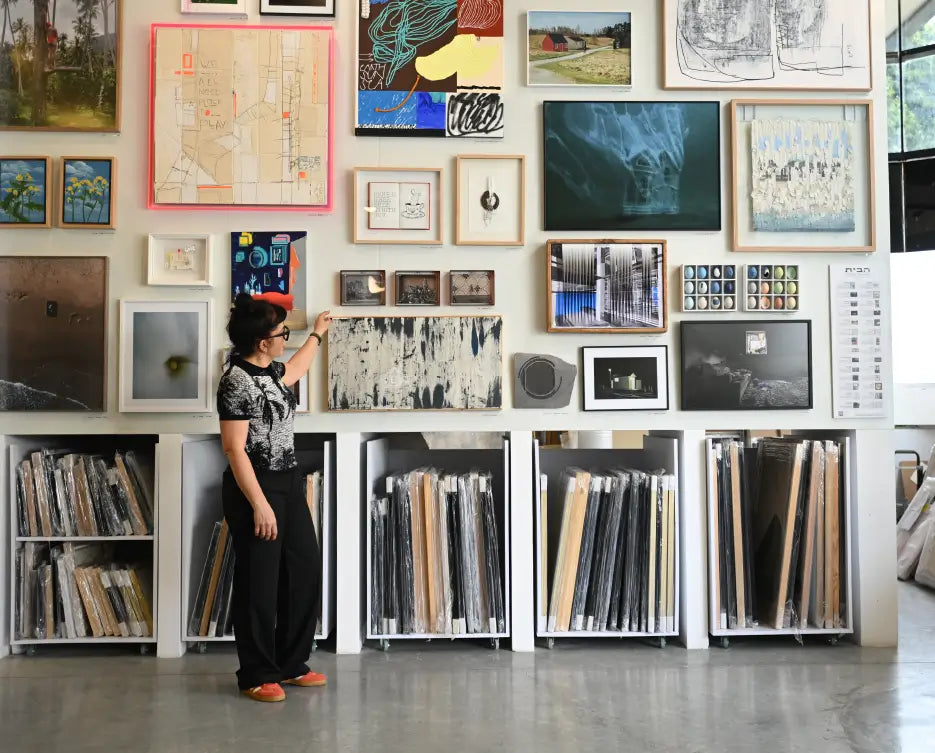
 Irit Hayon and Tal Ido, 1of135 gallery. Photos: Tami Bar Shai
 Photo: Tami Bar Shai
Irit: It’s unbelievable, and here we are marking a decade since that madness that took hold of me when I roped in Tal, my husband and my partner at work. As you know, I’ve owned a branding company for nearly 25 years, and after hundreds of branding processes, small and large, in Israel and abroad, we decided to establish an online gallery that would answer a need and a passion of us both. It was clear to us that our gallery would bring a different message to the field. A different way of looking.
Precisely in a world where galleries are perceived as a closed temple for connoisseurs only, we decided to establish a gallery that set itself the goal of making art accessible, and as I call it, “art in jeans.”
Yuval: Which year are we talking about? 2015?
Irit: Yes, May 2015. We wanted to break down the elitist walls of the field that to some degree created a distance that arouses apprehension. I hear many customers apologizing when they walk into the gallery and saying: “I don’t understand art, I don’t know which style, I don’t know how to judge whether it’s expensive or not…”
Those people left their walls bare, or alternatively chose some generic poster/print that fills the wall, undemanding, requiring no explanations. As far as we’re concerned, 1of135 changed the picture
(in both senses :)). The gallery meets customers exactly where they are: at eye level, with an open heart, and happily in jeans too – art at heart level! In our gallery on Kremenetski Street 2 you can touch the works, feel the material, sense, experience, and hopefully be moved too.
We created an exceptional space, we developed advanced tools to make art accessible - through the atmosphere, the technology, the very embracing approach. Only when a work touches you and grabs you does the journey begin. We mainly listen, open up options. We’re not really salespeople.
Yuval: So where do you begin?
Irit: The gallery began its path only with limited-edition works, by artists such as Jewboy (Yaron Shin), who served as head of the visual communication department at WIZO Haifa; Meirco (Meir Cohen), a fashion photographer; Merav Shacham, Anat Peri-Tal and others. One of the strengths that emerged very quickly and created our differentiation from the others is the ability to create encounters between different creators on the gallery walls – the eclectic approach very much characterizes me as a designer and a curator.
Thanks to being a designer, my view of the art world was different. I knew how to identify a need and turn it into a “product,” to hold a professional dialogue with the architects and designers and to contribute to them by integrating art into the various spaces. Beyond that, more than once I carried out office projects in which I did the branding process and afterwards we formulated the language of the art for the various spaces. In short, I move along the axis between design and art, bridging the two worlds.

Thanks to being a designer, my view of the
art world was different. I knew how to identify a need
and turn it into a “product,” to hold a professional dialogue
with the architects and designers and to contribute by integrating art
into the various spaces
I’m now reminded of the first exhibitions we took part in: design exhibitions! We showed at Ambiente in Frankfurt, at Design Week in the Exhibition Gardens, and the moving moment was when I was asked to curate the exhibition for Yitzhak Rabin marking 100 years since his birth.
Yuval: And today?
Irit: Today the gallery has, first of all, limited-edition works, signed and numbered. A series that ends does not return. Alongside them there are One of a Kind original works by the finest artists in Israel: Kate Priselis, Tamar Branitzky (who launched her first-ever art series! at our gallery 7-8 years ago in a solo exhibition), Ran Slavin, Jewboy, Omri Taub, Roi Nitzan, Karin Yankort (Ein Hod), and over the past year we have also been showing industrial design / product design pieces by Ada Yoels, Racheli Sharfstein, Shaul Cohen, Gabi Zaltzman and others.
Yuval: Following the entry of One of a Kind and design pieces: what has changed and what has stayed the same in terms of the audience and the market over the past ten years?
Irit: There were significant changes in the product mix, but we rigorously preserved two essential things in our vision. The first – only Israeli art and design – only Israeli artists and designers. Because we are very digital and on social media, we receive approaches from artists all over the world, very talented, and we have never given in to their requests to join the gallery.
The second – making art accessible – and not only at the price level, but through the technological tools we developed, the inviting and experiential space we created, the dialogue at eye level and above all the listening.
And our audience has also changed over the years. We feel that we have played no small part in educating the young audience to consume art. This is the first time that a student living in a rented apartment can purchase, out of the money from their delivery jobs, a work of art by Jewboy, for example; a signed, numbered work by an esteemed creator, and these are the moments that always moved us.
The close work with interior designers and architects on private and public projects surfaced a need for original works. There was no budget limit, and they wanted a One-Stop-Shop; they loved the conduct and the personal attention we are careful to provide, the listening to the stirrings of the client’s heart, and also to the client’s “budget stirrings.” Little by little we gathered the artists who bring with them a unique signature, and added them to our home.
We receive dozens of approaches from creators from Israel and the world every week. As a curator I am very selective, and over the decade we have about 50 artists, but each one is special and matches my personal preferences. We are not a supermarket of artists. In theory a website has no limit on space, I could add hundreds more artists like the big art sites in the world, but as a philosophy I refine the selection, and nurture them.
 Roi Nitzan and David Polonsky, A View to the Sea

Karin Yankort, A Balcony to the Horizon

Kate Priselis, MAGIC HOME

Irit Hayon, A PLACE TO PLAY. Photo: Ori Gron
Yuval: Let’s move on to the exhibition, The Home: what can you tell us about it?
Irit: I’ll start with a bit of background. Every few months we put out an open call to the gallery’s artists and curate an exhibition that we launch to interior designers and architects, and afterwards open to the general public. About a month and a half ago I put out an open call to the gallery’s artists and the response was moving and full. The theme of the exhibition is “The Home”: guarding, longing, presence and absence. It’s needless to explain why this theme was chosen, even though I didn’t dictate anything in the context of the period. It remained an open theme and everyone offered a renewed look at the subject of the home. For me, every work is a glimpse into a room in memory – some of the works are bathed in soft light, others are full of fragments. Longing is evident, and in some even hope. Maybe it’s the home that is no more, the home we dreamed of, or one we didn’t realize we had. A home to leave and to return to – and hopefully soon!!!!
Yuval: Give 2-3 examples of works?
Irit: Roi Nitzan and David Polonsky created, in “A View to the Sea,” a dollhouse sinking into the depths in a dreamlike image, which is part idyll, part nightmare, in an underwater photography technique. In “A Balcony to the Horizon” Karin Yankort created - in a technique that combines painting, photography and cutting of layers - a home as a place of refuge, exposed from the inside and the outside through a grid. About “The Magic Home” Kate Priselis writes: “The home is not only a physical place, but a shared ground. The sun, the sea and the earth are the inspiration on my journey. Planet Earth is everyone’s home.” And one more of mine ?!:)
Yuval: Go ahead.
Irit: A PLACE TO PLAY: the human need for a safe space where it’s allowed to imagine, to move and to exist. The climb from the bottom to the peak, from chaos to order. From pain to hope.
Yuval: Lovely. What else? Plans for the next ten years?
Irit: Our plans, broadly, are to keep doing exactly what excites us every morning. To be in a state of listening and alertness to developments in the field, in the arena and in the world as a whole. To advance the field of art and design in our modest, pleasant and embracing way. To support talented Israeli artists and to give them a worthy and appreciative stage. I truly believe in small steps and listening to changes. We saw this clearly in the shifts in trend during the Covid period and since October 7th, so that very tattoo on my arm that says I Always Choose The Window Seat reflects my thirst to see, to absorb, to be inspired, not to miss out and to be sensitive to changes, to feelings, and to act accordingly. Does that answer the question? Did you expect me to write a chain of branches around the world? Well no, our direction is here. Close to home. And to our daughters.
Yuval: What else? Anything important to add before we part?
Irit: Yes, it’s important to me to note only that part of the total sales of the works in the exhibition will be transferred as a donation to the Hostages and Missing Families Forum for the return of the hostages. We long for the return of all the hostages, and of course for the soldiers to come back safe and sound.

The Home
1of135 Gallery, Kremenetski 2, Tel Aviv.
Participants: Ran Slavin, Shaul Cohen, Kate Priselis, Tamar Branitzky, Gabi Zaltzman, Jewboy (Yaron Shin), Meirco (Meir Cohen), Karin Yankort, Gila Greenfield, Yaara Rabinovich, Roni Almagor, Galit Deutsch, Irit Hayon, Tal Paz-Fridman, Ada Yoels, Omri Taub, Shlomi Shiloni, Yotam Schwartz, Roi Nitzan, Shunit Falko-Zaritsky, Nona Keren, Nirit Ovadia, Hamutal Yaakobovich.
Opening: 19.5; Closing: 26.5